
Business Process Automation in El Paso: The Second Country in Your Workflow
By Dallas Coleman ·
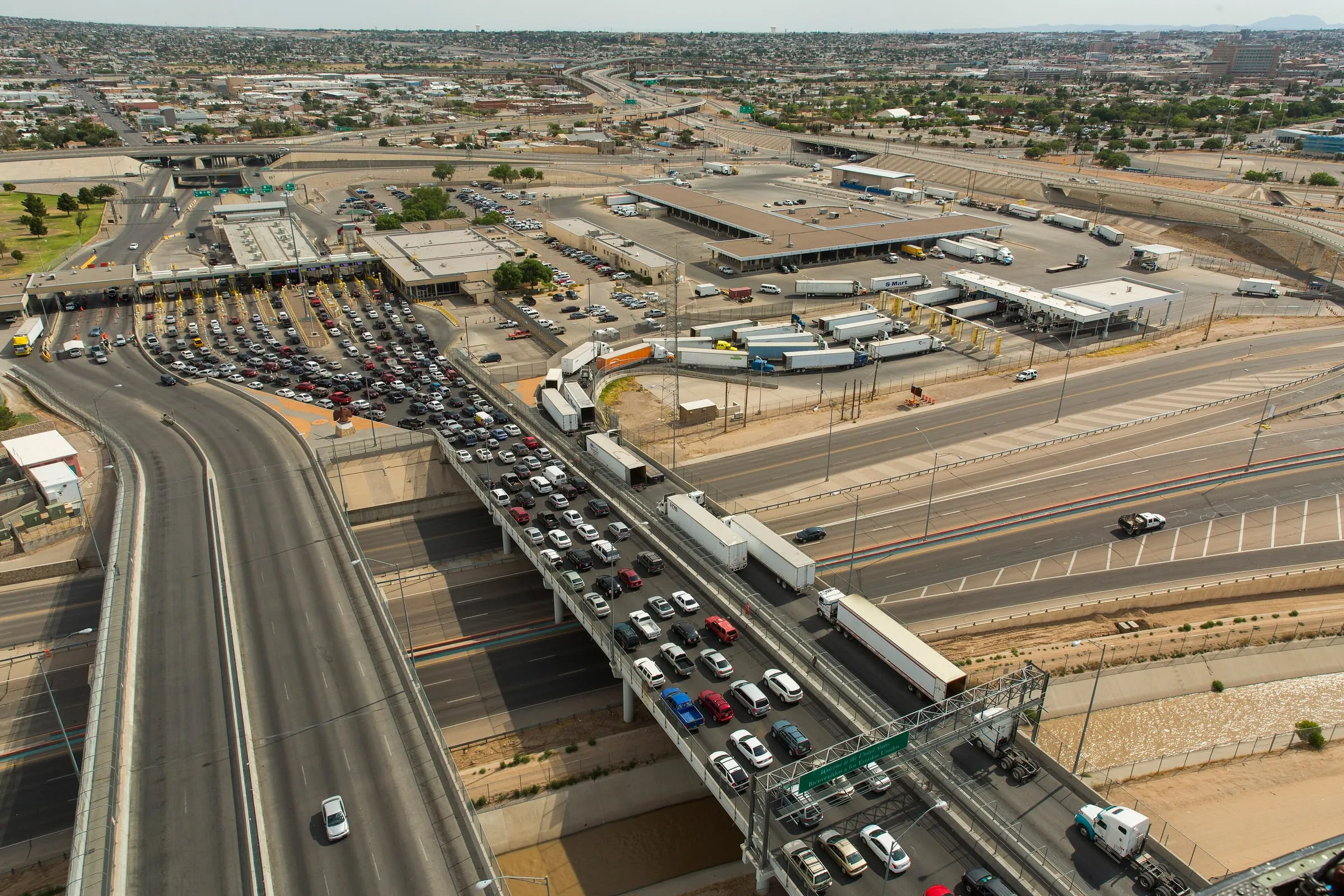
Most automation advice assumes one set of rules. A border business runs on two. The same load has to satisfy a customer’s purchase order, a carrier’s paperwork, a broker’s entry, an inventory record, and an accounting package built for domestic freight, and every one of those parties wants the same handful of facts in its own format. That is not a paperwork problem. It is a data problem solved by hiring people to retype things.
El Paso and Ciudad Juárez function as one economy with a border through the middle of it — after San Diego and Tijuana, the largest binational metro on the line — and the operations here reflect it: manufacturers with a plant or a supplier across the line, logistics and warehousing along I-10, cold storage moving produce north, service businesses built around the crossing. In all of them, the expensive workflows are the ones with a second country in them.
Where do the hours actually go in a cross-border operation?
They go into describing the same shipment more than once. Trace a single load and count the keystrokes. A part number and a weight are entered when the order is taken, again into the document set the broker needs, a third time into the carrier’s portal, a fourth when the warehouse receives it, and once more when someone builds the invoice. Nobody designed that. It accumulated one system at a time, and each addition was reasonable on the day it arrived.
Two costs come out of that, and only one is on anybody’s radar. The visible cost is labor: the rekeying, plus the phone time when two versions of a fact disagree. The invisible cost is the discrepancy itself. A weight that does not match, a description that does not match the commercial invoice, a piece count off by one — those are created at the keyboard, and they are discovered at the bridge, with a driver sitting in line and a customer’s production schedule already moving.
So the first thing worth mapping is not a department. It is the moment an order becomes a crossing document, because that is where a fact gets restated by hand and a typing error becomes a delay nobody can price until it has happened.
What can automation legitimately do about customs paperwork?
It can assemble documents from a record you already hold. It cannot decide what belongs on them, and you should be suspicious of anyone who says otherwise.
That line matters. Classification, valuation, origin determination, and anything touching a specific entry are regulatory questions that belong with the customs broker and the trade attorney the business already uses. CMA is not a customs broker, a trade attorney, or a compliance firm, and an operations consultant who starts advising on tariff treatment is doing something they are not qualified to do.
What is squarely an operations problem is everything around that judgment. Commercial invoices and packing lists assembled by hand in a word processor, from data that already exists in an order. Broker instructions retyped into email. A certificate of origin whose supporting facts live in four places. And the classification data itself — the codes, the origin determinations, the duty notes your broker has already given you — sitting in a spreadsheet on one desktop, neither backed up nor connected to the part master that feeds your documents. The determination is the broker’s. The record of it is yours, and it belongs with the part, not in a tab named “final v3.”
Why does nobody learn about a crossing delay until the customer calls?
Because the delay is not recorded anywhere as an event. It exists as the absence of an event, and absences are exactly what a spreadsheet-based process cannot show you.
Everything in a normal system records that something happened: an order entered, a truck dispatched, an invoice sent. Nothing records that a load which should have crossed by ten has not crossed by two. Somebody notices eventually, usually the owner, because a customer asked, and by then the recovery options are smaller and costlier than they were four hours earlier.
The fix is a rule, not a report. Define the expected event and the hour it is expected by: crossed, received, released, delivered. When the clock passes without it, the exception raises itself to a named person, with the reference number and last status attached. That is the difference between automation that makes normal work faster and automation that makes abnormal work visible. Where a held shipment is the most expensive routine occurrence, the second kind is worth more.
The same logic runs downstream. Much of the phone traffic in a border logistics business is somebody asking where their freight is, which means someone stops what they are doing to look it up. Status the customer can see without calling removes that interruption, and it changes what they think of you when something goes wrong, because they saw it when you did.
What about bilingual documents and two sets of rules?
Treat language as an output format, not as a second document. The failure mode is drift: an English procedure and a Spanish procedure, both maintained by hand, and after the third revision they no longer say the same thing. Whichever one the plant is reading becomes the real process, and nobody on the US side knows which that is.
The same discipline that fixes the document set fixes this. Hold the facts once, render them in the format and the language each reader needs, and version the source rather than the renderings. Where a document must satisfy requirements on both sides of the line, the content questions still go to the specialist; what you are automating is assembly and version control, which is where a hand-built process breaks.
Warehousing and cold storage on the I-10 corridor add a version of this that has nothing to do with the border. Temperature logs, inbound receipts, lot and case counts, and a customer’s portal each want the same data in their own shape, usually captured on a clipboard because no one has connected them. Real, required work, done twice.
Do you buy trade software or build something?
Buy first, and exhaust what you own before either. Customs software vendors and broker platforms solve a genuine part of this, and if your volume justifies one, it will beat anything custom on price and maintenance. Many brokers and carriers will also accept data directly rather than by email, and that one connection is often the cheapest item on the list.
The point where buying stops working is the seam. If a plant in Juárez, a broker, a warehouse system, and an accounting package each hold their own version of the same shipment, no configuration inside any one of them reconciles the four. At that point you are choosing between paying people to reconcile it every week and building the layer that holds the shipment record once. Add up what the current stack costs before you decide: the software stack cost calculator is a two-minute version of that exercise, and the total is usually larger than the owner’s estimate.
Targeted process automation builds start at $10,000 when the systems are staying and the wiring between them is the job. When the systems themselves are the problem, an operations platform build starts at $5,000 for Essential, $8,500 with a module such as inventory or field service, and $15,000 for multi-location and custom workflows, run yourself from about $80 a month in infrastructure or handed back at $450 a month managed. The Operations Audit is $3,500; the $500 Workflow Map documents one workflow end to end and is credited against it. Either way, what you keep matters more than the demo: the code, the data, and the documentation, or you have rented the fix.
Do you need an El Paso firm to do this?
No, but you need someone who will stand in the yard. CMA is based in Dallas. There is no El Paso office and no El Paso staff, and any firm claiming a local presence should be asked to name the address. We travel to El Paso for the on-site portion of an engagement, with that travel written into the scope up front rather than added to an invoice later, because a workflow spanning a plant, a broker, a bridge, and a warehouse cannot be understood over video.
Before any of it is automated, the process has to exist on paper. If the real workflow is one dispatcher’s judgment about which broker to call and which document to fix first, start with SOPs, which are how small businesses scale, and expect that exercise to be most of the value. The scope, sequence, and published prices for this market are on the El Paso process automation page.
If you want a ranked read on where the rekeying costs you most, the two-minute automation audit scores eight questions and hands back a starting point. Or book a 30-minute call and bring one load’s paperwork end to end, which tells you more than any demo will.
This commentary is provided for general informational and educational purposes only and reflects the author's analysis as of the publication date. It is not legal, tax, accounting, investment, or securities advice, and it does not create a consulting or advisory relationship. Third-party names and trademarks are the property of their respective owners. See our full disclaimer.
Go Deeper · Free Handbook Process Automation for Small Business The full playbook behind this topic — read online or download the PDF.Related reading

Running an Operation That Survives Turnaround Season
Demand arrives in bursts around turnarounds and storms. What to write down before the surge so the operation does not run on whoever remembers.
From Field Ticket to Invoice: Where Industrial Contractors Lose Cash
The gap between a signed field ticket and a sent invoice is working capital. What to capture at the point of work so the invoice assembles itself.

Writing a Business Plan an Out-of-Market Lender Will Underwrite
A border business is often underwritten by a committee in another state. What the plan must explain: structure, currency, collateral, the slow case.