
What You Keep A year from now, what is still running?
Every firm in this category tells you that you will own the result. They mean different things by it, and the difference only becomes visible after someone leaves, a vendor changes an API, or a renewal lands. Here is the honest version of each.
The question
Ask it about the second year, not the first
In the first month every one of these looks the same: something that was manual is not manual any more. The differences are structural, and they surface later. One test separates them cleanly, and it is worth asking whoever you hire, including us.
“If we stopped paying every software vendor in this stack next year, what would still be running — and could my team operate it without you?”
There is no universally correct answer. A business whose tools genuinely fit should want the light leftover and should not pay for anything heavier. The mistake is not picking the wrong one; it is not knowing which one you bought until the year is over.
Side by side
What each approach leaves behind
| Approach | What you keep | What it exposes you to | When it is the right buy |
|---|---|---|---|
| Automations on your current tools Zapier, Make, and the automation built on top of whatever you run today | A set of automations wired between subscriptions you keep paying for, plus whoever understands them. | They break quietly when a vendor changes an API, and the person who built them is the documentation. | The tools are right and only the handoffs are wrong. This is the cheapest correct answer, and often ours. |
| A build inside a vendor platform Custom apps and flows built in Microsoft 365, Power Platform, Salesforce and the like | Real software, running in a tenant you rent, in a format that only works while you keep renting it. | Per-seat pricing follows headcount, and leaving means rebuilding rather than exporting. | Your company already lives in that ecosystem, pays for it regardless, and has no intention of leaving. |
| Self-hosted open-source glue n8n and similar orchestration you host, with your own API keys | Workflows and keys you genuinely control, sitting between the same applications as before. | You have taken on hosting, upgrades and security, and the underlying sprawl is untouched. | You have a technical person who wants that control. This is a legitimately good answer for that team. |
| Automation inside an IT retainer A managed service provider adding workflow work to the monthly bill | Flows maintained by the provider, for as long as the retainer runs. | The automation is a line item on a relationship built for devices, networks and security. | Your real problem is IT — helpdesk, endpoints, security, uptime. That is their trade, and not ours. |
| A system built to be handed over The CMA Operations Platform | One operating system holding your customers, jobs, documents and numbers, which you own outright, with the data and the option to run it yourself. | It is a bigger decision than a workflow, and it is the wrong one if the tools you have already fit. | The stack itself is the problem: too many systems, none of them agreeing, and the integration work is a person. |
Read the comparisons in full: zaps versus one system, a Microsoft 365 build, self-hosted orchestration, an IT retainer.
The transfer
Handing it over is the last step, not a favor
CMA works in three moves: Embed inside the operation to see how the work actually runs, Build the system that carries it, and Transfer it to a team that can run it without us. The third step is the one that decides what you keep, so it is scoped from the beginning rather than improvised at the end: documentation, training, and the choice of running it yourself or having us run it.
Read the method in full on the CMA Method, or see what the platform includes.
What it costs to find out
- Workflow Map — $500, one workflow written down as it actually runs, credited against the audit
- Operations Audit — $3,500, the whole operation mapped and ranked
- Operations Platform — from $5,000 to build, then From $80 / month self-run or $450 / month managed
Ask us the second-year question.
Things We Have Built
Systems that are still running
Three platforms we designed, built and handed over. Each one replaced a stack of subscriptions and group chats with something the owner holds.
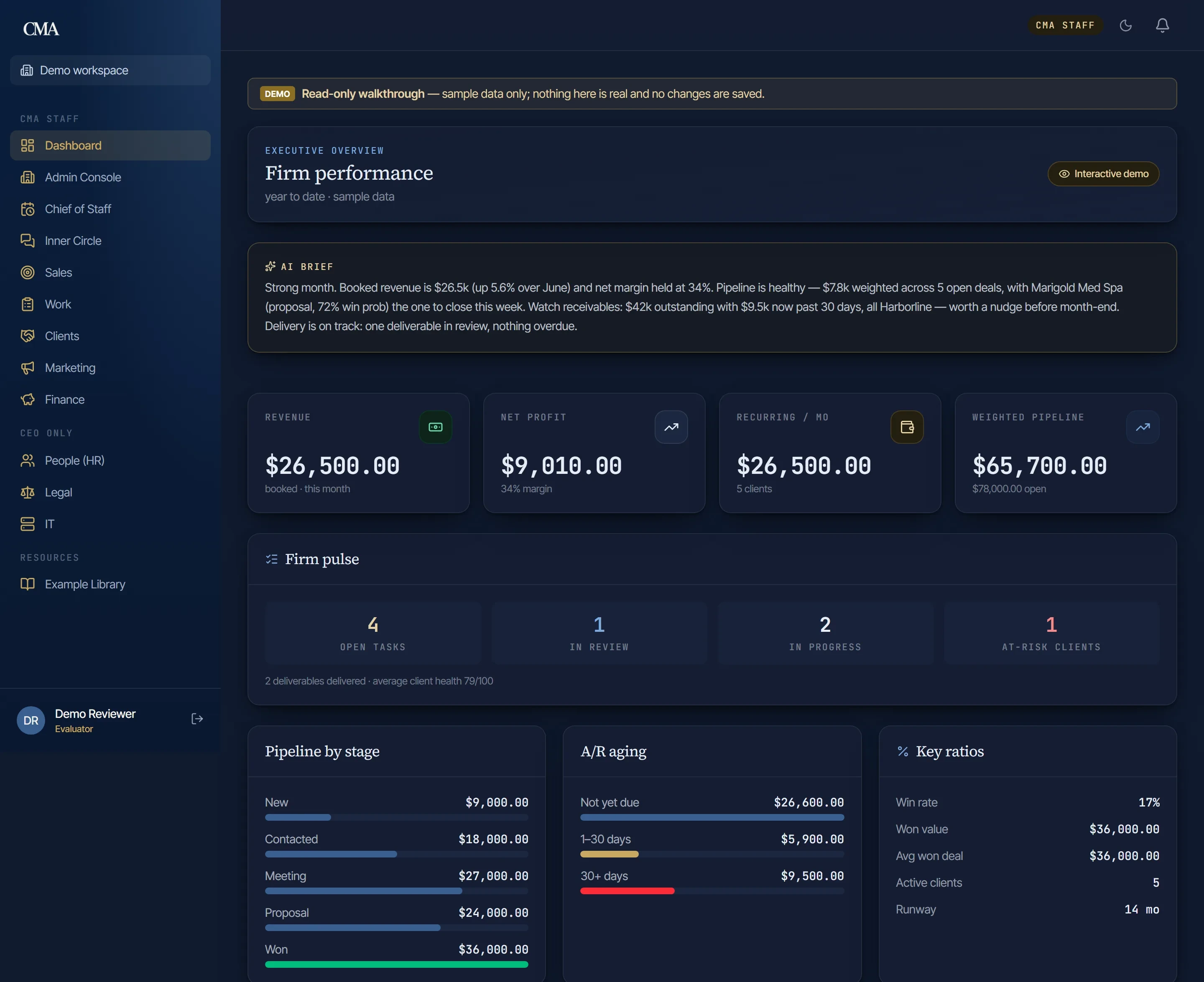
Multi-tenant operations platform
CMA Client Portal
CMA's own product
A multi-tenant client portal — scheduling, deliverables, and QuickBooks-synced billing. Built and run in-house.
See how we built CMA Client Portal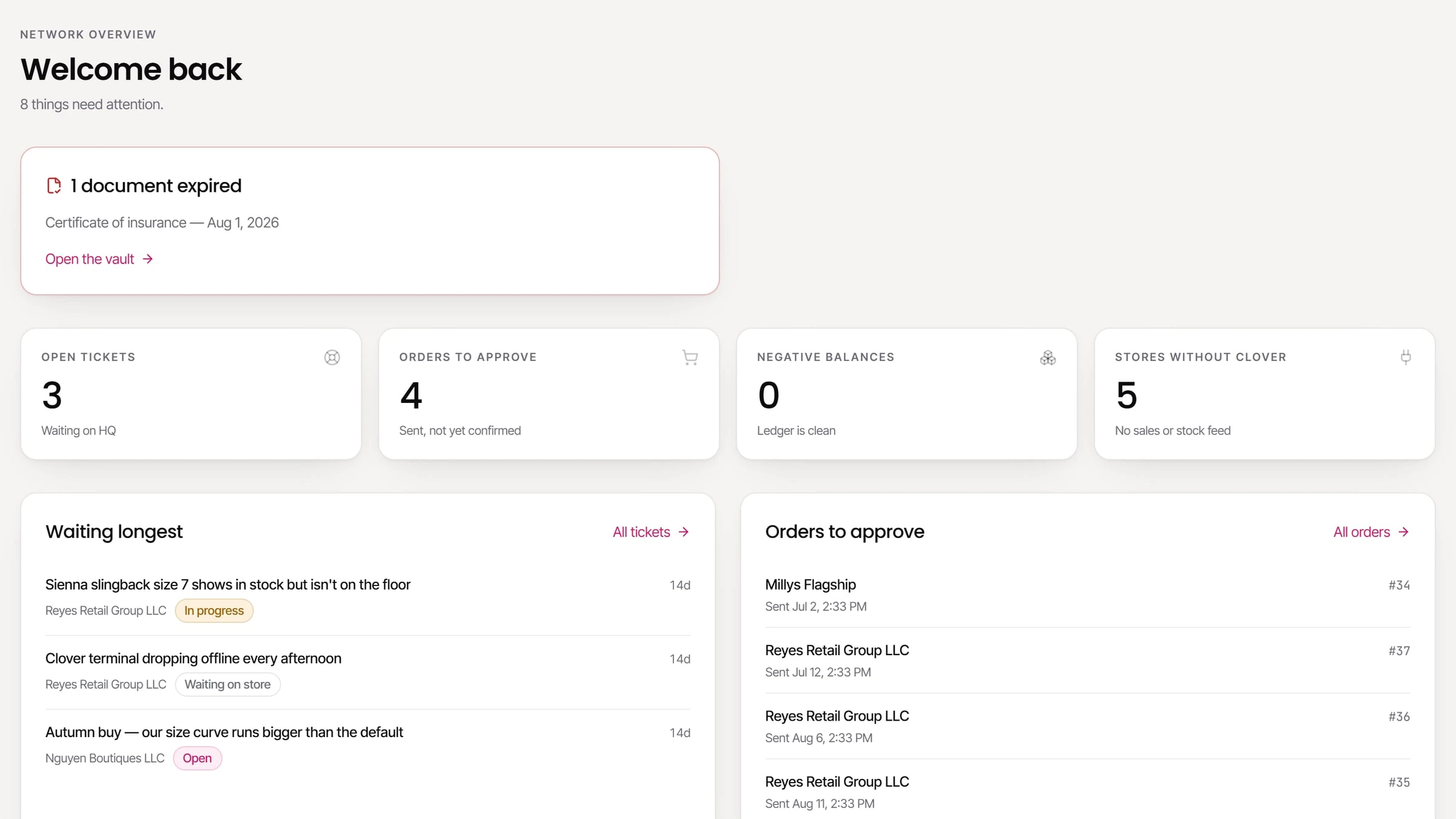
Franchise operating system
Milly's Franchise Portal
Built for Milly's — Rio Grande Valley, TX
A franchisor console, a franchisee portal and a warehouse ledger — the operating system behind a multi-store footwear franchise.
See how we built Milly's Franchise Portal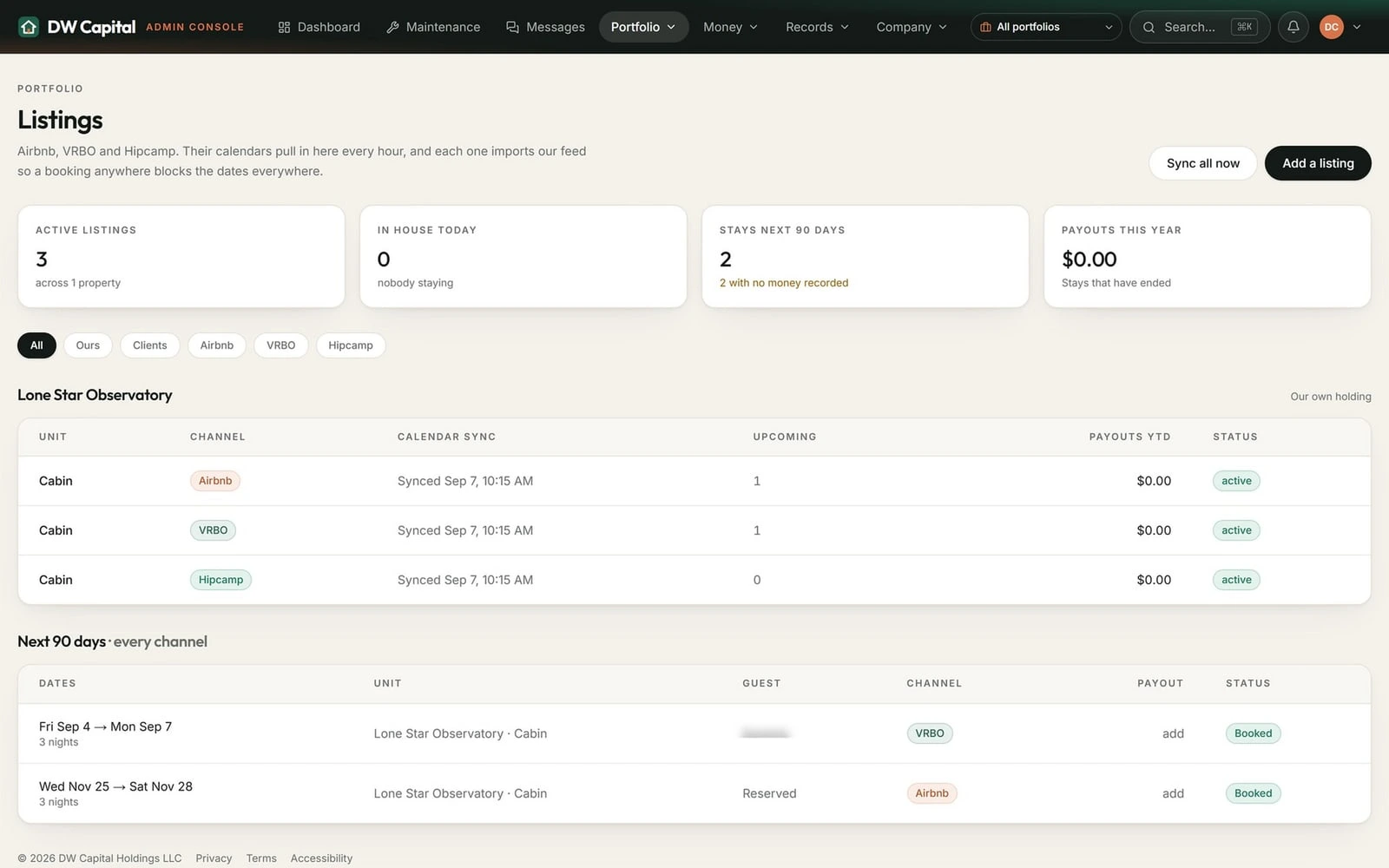
Property management platform
DW Capital Portal
Built for DW Capital Holdings
A property-management platform for long-term and short-term rentals: leases, rent and maintenance, channel calendars and owner statements.
See how we built DW Capital PortalFrequently asked
Ownership questions
What do I actually own when the engagement ends?
The system and the data in it, plus the documentation to run it. A build is yours outright: you can host it yourself from about $80 a month depending on size and usage, or have CMA host and run it for $450 a month, and you can move from one to the other. Nothing about that choice is a lever we hold over the relationship.
Everybody says the client owns the result. What is different here?
Most of the time the thing owned is a set of automations between tools you still rent. That is a genuine deliverable and sometimes the right one, but it is not the same asset. The question worth asking any firm is narrower: if we stopped paying every vendor in this stack next year, what still runs? For flows inside a rented platform the answer is nothing.
Does a rebuild replace all of my software?
No, and any firm that says otherwise is selling. Accounting, payroll, email and the specialist tools your trade depends on stay. What a rebuild replaces is the accumulated middle: the four or five overlapping tools that exist to hold customers, jobs, documents and numbers, plus the manual work of keeping them in agreement.
What happens if we stop working with CMA?
You keep the platform, the data and the documentation, and you can take it in house. That is the transfer step of the method, not a concession. If you would rather someone else run it, the system does not stop working because we are not the ones hosting it.
Is there a cheaper way to find out which of these I need?
Yes. The $500 Workflow Map takes one workflow, watches it end to end, and writes down what it actually costs in hours and errors. That is usually enough to tell whether you have an automation problem or a stack problem, and it is credited against an Operations Audit if you go further.
Work out what the current arrangement costs
The subscriptions are the visible part. The hours between them are usually the larger number.
- Veteran-owned
Founded and led by a U.S. Army veteran
- Dallas, TX
Downtown Dallas, on site across Texas
- Published prices
Fixed in writing before work starts
- Built to transfer
You own the system at the end