

Accounting Firm Automation: Fix the Document Chase
Accounting firm automation works when you sequence it: document collection first, then close, then status. What to automate and what a consultant costs.
Small businesses don't need a science project — they need repetitive work off their plate. We audit your operation, build the automations that actually pay off, and keep your team in control of every one.
The Outcome
Not a science project — measurable operating leverage, with the discipline to capture it safely.
Hours back, every week
The repetitive work that eats your team’s day, automated — and measured against the hours it returns.
A roadmap ranked by ROI
An audit that tells you exactly what to automate, in what order, and what each is worth before you spend.
Systems your team can run
Built into your operation with training and guardrails — adopted, not abandoned.
Who This Is For
You've seen the hype and you suspect there's something real underneath it — but you're running a small or mid-market business, not a lab, and you don't have time for experiments. This is for owners who want repetitive work automated, operational data visible, and a team that runs the systems competently and safely — delivered as a structured program with measurable returns, not a pile of tools nobody adopts.
We're based at 1910 Pacific Avenue in downtown Dallas, so Dallas–Fort Worth businesses — Dallas, Plano, Frisco, Richardson, Arlington, Fort Worth and the suburbs between — get on-site working sessions with no travel premium. We work on site in Austin and San Antonio as well, and travel to Houston, El Paso and Corpus Christi for the on-site part of an engagement, with the travel scoped up front. Everyone else gets the same program remotely, nationwide.
If you are weighing this against putting a capable person on the problem instead, that is a fair question and we wrote it up: hiring an operator versus rebuilding the process.
Industry focus
Automation tailored to how your industry actually runs:
Plain English
Skip the hype. An AI agent is just software that can take a few steps on its own toward a goal you set — read something, decide, act, and hand off — instead of waiting for a person to click through every step. For a small business, that means a specific, bounded job gets done without someone babysitting it. Here's the honest version of what that looks like:
Inbound leads, triaged and answered
A new inquiry comes in; the agent pulls the details, drafts a first reply in your voice, and routes it to the right person — so nobody loses a lead over a slow weekend.
Invoices and follow-ups that chase themselves
The agent watches what's unpaid, drafts the reminder matched to each customer's history, and queues it for your okay — turning “I'll get to it” into money in the account.
First-line customer questions, handled
Routine “where's my order / are you open / how much” questions get answered from your real information, and anything it's unsure of gets escalated to a human — not guessed at.
The weekly numbers, assembled for you
Instead of someone stitching a spreadsheet together every Monday, the agent gathers the data and drafts the summary — you review a finished report instead of building one.
The honest line
None of these is a robot running your company. Every agent we build is scoped to one job, wired into the tools you already use, and kept human-in-the-loop — it drafts and prepares; you approve anything that reaches a customer or your books. The cheapest automation is often a feature you already pay for and never switched on, and we'll tell you when that's the answer instead of selling you a build. More on the discipline behind it: what to actually do about AI agents now.
The Practice
A systems-first engagement that removes repetitive manual work and gives you operational visibility — built on your actual workflows, not a generic playbook. See a sample dashboard →
What this is: a comprehensive operational transformation. We assess, design, build, and train — real automations, AI agents, and dashboards for your specific operations, with governance that keeps your team in control.
What this is not: a "learn ChatGPT" workshop, a prompt pack, a tool recommendation without implementation, or a replacement for your people. Everything is customized, implemented, and supported — and your team ends the engagement more capable, not more dependent.
Related Practice
Website creation, redesign, landing pages, conversion optimization, and ongoing support are now a full CMA practice of their own — built and run with the same execute-first standard.
What it costs
You should not have to buy an engagement to find out whether you need one. Each step below is fixed-price and written down before it starts, and each one is worth doing on its own. If the process itself needs fixing before anything is automated, that is process optimization, priced on the same three steps. There is no hourly rate anywhere in this practice.
Step one · start here
$500
One workflow, watched end to end as it actually runs. You get it written down with the hours, the handoffs and the failure points marked, plus the one change worth making first. Credited in full against the Operations Audit if you go further.
Best when you suspect a specific process is bleeding time and want evidence before spending.
Step two
$3,500
The whole operation mapped: where the hours and errors actually sit, a measured baseline, and a roadmap ranked by return rather than by novelty — including the items that are not worth automating at all.
Best when you know the operation is inefficient but not where to start.
Step three
from $10,000
The automations on the roadmap, built into the tools you already run, with human-in-the-loop controls at every step where a wrong answer would be expensive, then measured against the baseline from the audit.
Scoped as a fixed-price project against the roadmap, never an open meter.
If the stack itself is the problem
Automation makes a stack you intend to keep work better. When there are simply too many systems for any amount of glue to hold together, the honest answer is a rebuild: the Operations Platform, from $5,000 to build and yours outright, then From $80 / month self-run or $450 / month if we run it. Work out which side you are on with the stack cost calculator, or see what each approach leaves you holding.
Run Your Numbers
Reporting, onboarding, invoicing, data re-entry, follow-ups — repetitive work has a real payroll cost. Estimate what disciplined automation could hand back.
Your estimate
Team hours reclaimed each year
600 hrs
Annual payroll value of that time
$21,000
The Operations Audit identifies exactly which workflows carry this return — ranked by ROI before anything gets built.
Illustrative estimate from your inputs (50 working weeks). Not a quote or financial advice.
Not sure how much of your work is automatable? Take the 2-minute audit →
How It Works
A 60–90 minute diagnostic: workflow mapping, bottleneck identification, tool inventory, and your AI readiness score.
A prioritized automation plan ranked by ROI — what to build, in what order, and what it returns.
Automations, dashboards, portals, and AI assistants built into the tools you already use.
Hands-on team training plus governance and privacy policies, with human-in-the-loop safeguards.
Ongoing QA and optimization as your business and the tools evolve.
Proof
Automation shops describe what they would build. These are three systems CMA designed, shipped and handed over, with the figures counted from the repositories that run them.
CMA
Milly's — Rio Grande Valley, TX
DW Capital Holdings
Every system above is in production today. See what each one does →
Things We Have Built
Three operating platforms we designed and shipped — a franchise network, our own firm, and a property portfolio. Each one replaced spreadsheets and group chats with a system.
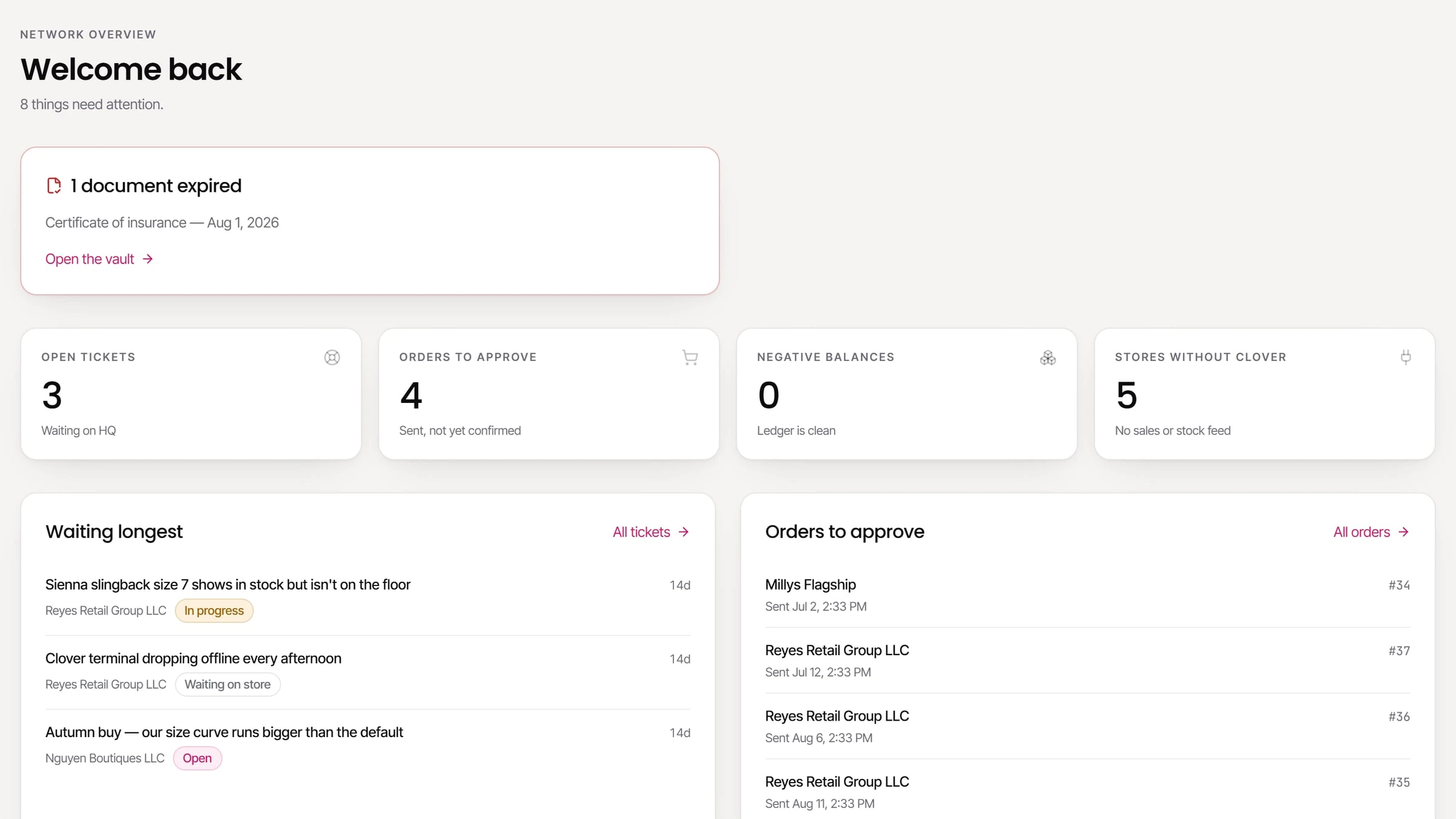
Franchise operating system
Built for Milly's — Rio Grande Valley, TX
A franchisor console, a franchisee portal and a warehouse ledger — the operating system behind a multi-store footwear franchise.
See how we built Milly's Franchise Portal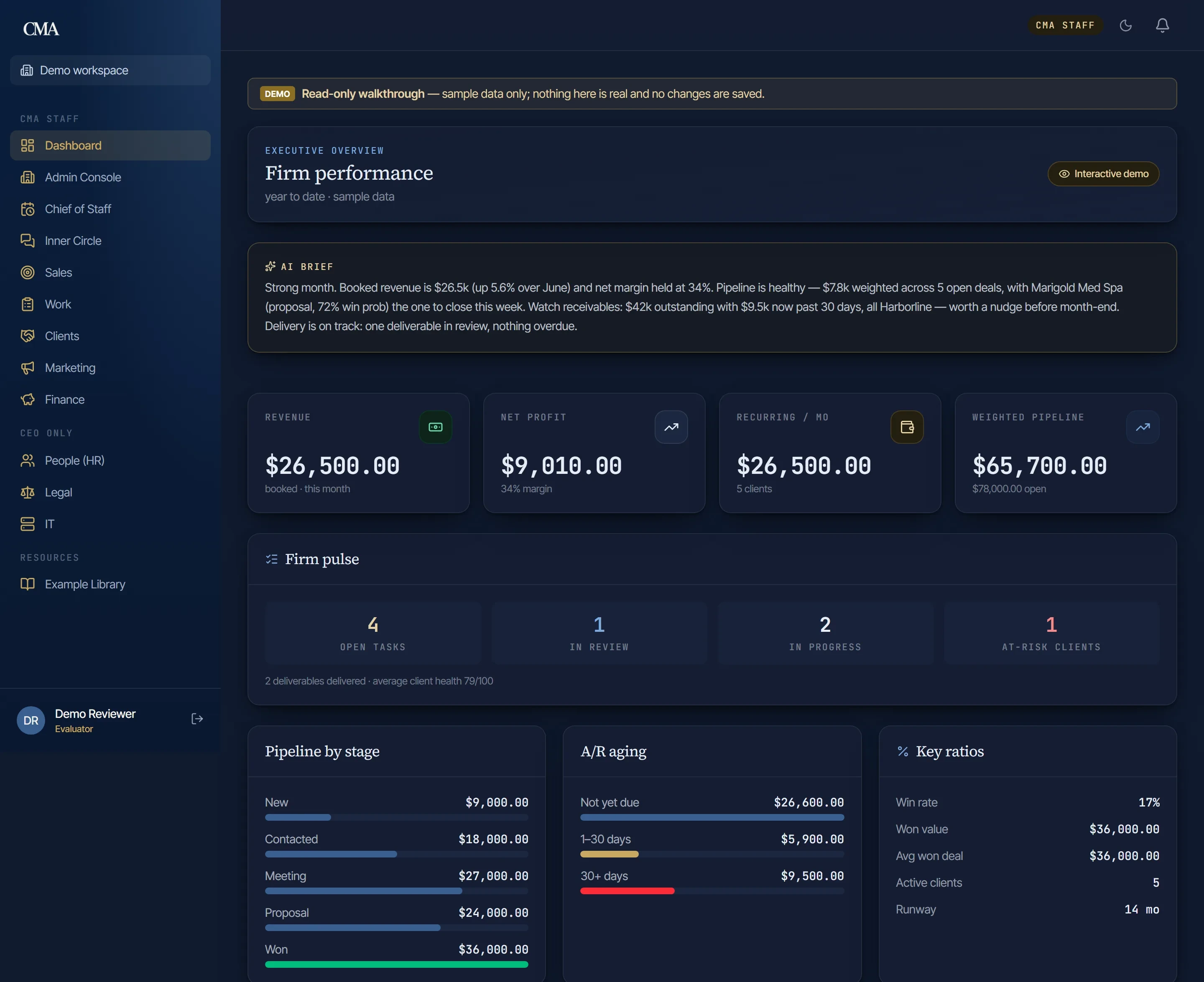
Multi-tenant operations platform
CMA's own product
A multi-tenant client portal — scheduling, deliverables, and QuickBooks-synced billing. Built and run in-house.
See how we built CMA Client Portal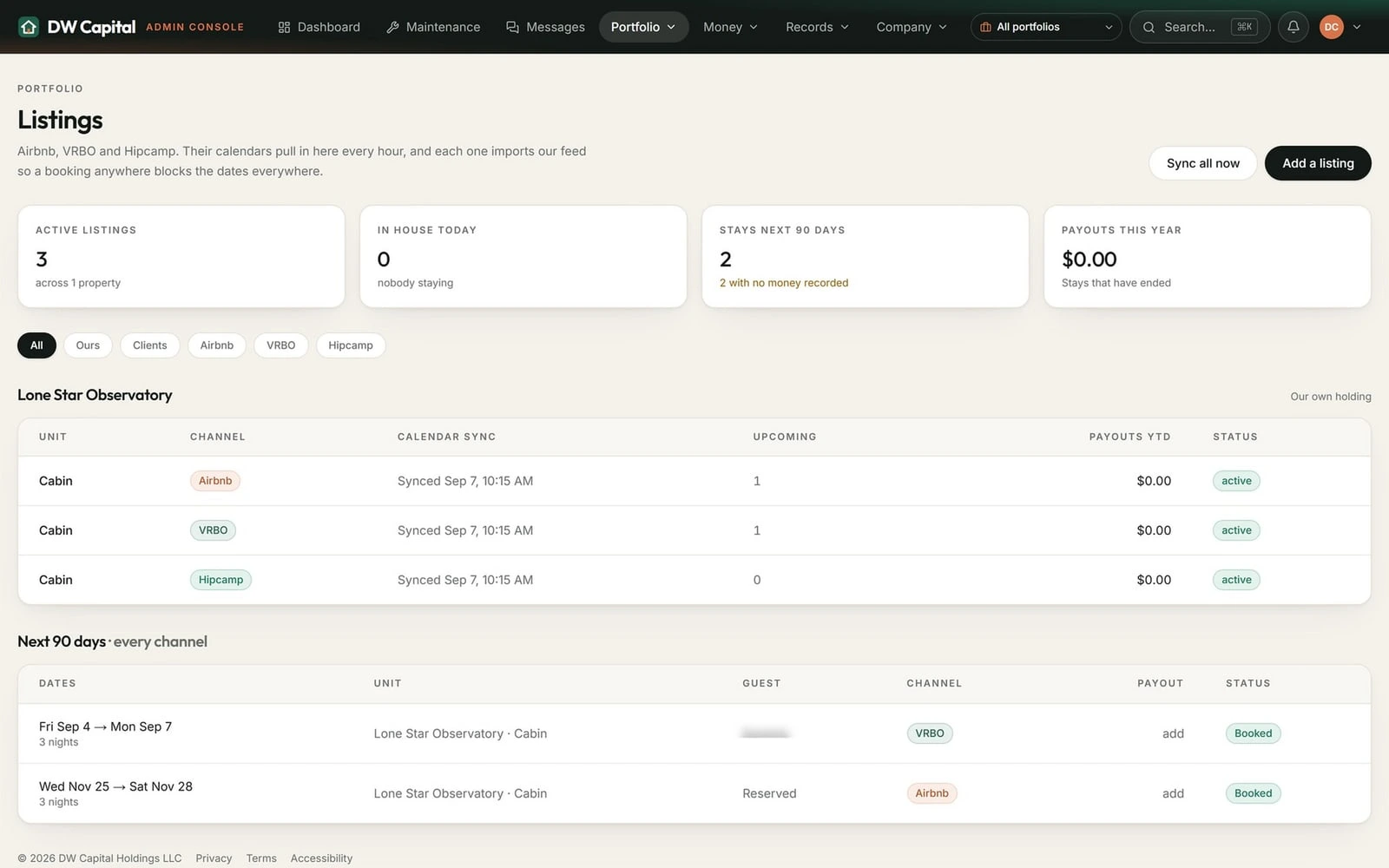
Property management platform
Built for DW Capital Holdings
A property-management platform for long-term and short-term rentals: leases, rent and maintenance, channel calendars and owner statements.
See how we built DW Capital PortalRelated reading
Accounting firm automation works when you sequence it: document collection first, then close, then status. What to automate and what a consultant costs.

Automation consulting in Frisco usually starts with back-office paperwork. For appointment-based businesses, the money is in the empty slot on the calendar.
Retail workflow optimization starts on the sales floor, not in software: the seven store workflows where labor hours leak, and the order to fix them in.
FAQ
Three published steps. A $500 Workflow Map takes one workflow, watches it end to end and writes down what it costs in hours and errors — credited in full against the audit if you go further. A $3,500 Operations Audit maps the whole operation and returns a roadmap ranked by return. Builds are then scoped as fixed-price projects, from $10,000, against that roadmap. There is no hourly rate, and scope and price are fixed in writing before any build starts.
The $500 Workflow Map. One workflow, watched as it actually runs rather than as it is described, written up with the hours, the handoffs and the failure points marked. If the honest answer is that a feature you already pay for solves the problem, that is what the map will say — and it costs you $500 to find out instead of the price of a build.
Automate when the tools are right and the handoffs are wrong; replace when there are too many tools for any amount of glue to hold together. Automation on your existing stack starts at the audit above. A replacement is the Operations Platform, from $5,000 to build, which you then own outright. The stack cost calculator gives you the arithmetic for your own numbers, and we will tell you which side you are on before anyone quotes a build.
A structured consulting engagement that takes your business from AI-curious to AI-operational: we audit your workflows, design and build automations, dashboards, and AI assistants for your specific operations, then train your team to use them safely. It is a transformation program — not a ChatGPT workshop or a one-off tool setup.
Yes — that is exactly who it is for. Everything we build is designed for non-technical teams, and training is part of every engagement. We also implement human-in-the-loop safeguards so your people stay in control of every consequential output.
More than most owners expect: reporting, client onboarding, invoicing, proposal generation, data entry between systems, appointment follow-ups, and internal status updates are common wins. The audit phase identifies which of your workflows have the best return — we automate by ROI, not by novelty.
No — and we design against it. The goal is to make your existing team more capable by removing repetitive manual work, not to make people redundant. Clients typically redeploy the recovered hours into revenue-producing and customer-facing work.
Governance is built in from day one: usage policies, data privacy guardrails, tool vetting, and human-review checkpoints for sensitive outputs. You get a written AI policy your business can stand behind — increasingly something customers, partners, and insurers ask about.
A custom-built site on your own domain, mobile-optimized with click-to-call, launched in days rather than months. Choose Build & Maintain (setup plus monthly support covering hosting, SSL, and content updates) or Build Only (one-time payment, you own everything outright).
The Platform
If the tools mostly work and the handoffs do not, automation is the right call. If you are paying for a dozen subscriptions that do not talk to each other, the platform replaces them.
The Full Practice
The Journal, By Email
Engagement lessons, funding math, and operations playbooks — the same analysis we publish in the Journal, delivered when it's written. No gates, no drip sequences, no selling between the lines. Unsubscribe anytime.
Founded and led by a U.S. Army veteran
Downtown Dallas, on site across Texas
Fixed in writing before work starts
You own the system at the end
Start with an operations audit. Know exactly what to automate, in what order, and why.
Talk to the firm. Thirty minutes, no pitch — a clear read on where you stand.
Talk to the firm
Ask CMA
AI assistant · replies in seconds
Before You Go
Our Funding-Readiness Report breaks down what separates funded businesses from rejected ones — with real data, not opinions. Read it free, and we'll add our 3-statement financial-model template too.
You're all set — here are your links:
No spam, ever. Or just read the report now →