
Consumer Software
Tailr: Building an AI Styling Product Around the Clothes People Own
Tailr - CMA-owned consumer product
By Dallas Coleman · Updated
Inside the build
The product. The workflow. The work you can see.
CMA built Tailr end to end: brand identity, marketing website and an AI styling experience that connects a personal profile, an existing wardrobe and complete outfit recommendations. The case shows how product positioning becomes a usable workflow, from the first question to the pieces in a finished look.
- Built for
- CMA-owned product
- Work delivered
- Web Apps · Process Automation · Brand & Identity
Tailr product walkthrough: profile, outfits and color analysis
A silent product walkthrough showing Tailr’s profile, outfit and color-analysis flow. Captions and a written visual description are available.
Read the video description
- 00:00 — Tailr introduces styling around the clothes a person owns, then shows the website and its product promise.
- 00:08 — The profile and outfit screens connect personal preferences to a complete look, individual garments and an explanation of why they work together.
- 00:23 — The color-analysis flow asks for appearance details and presents a seasonal palette.
- 00:34 — An occasion-based styling flow moves from a wedding-guest request to an outfit with the pieces and styling notes shown.
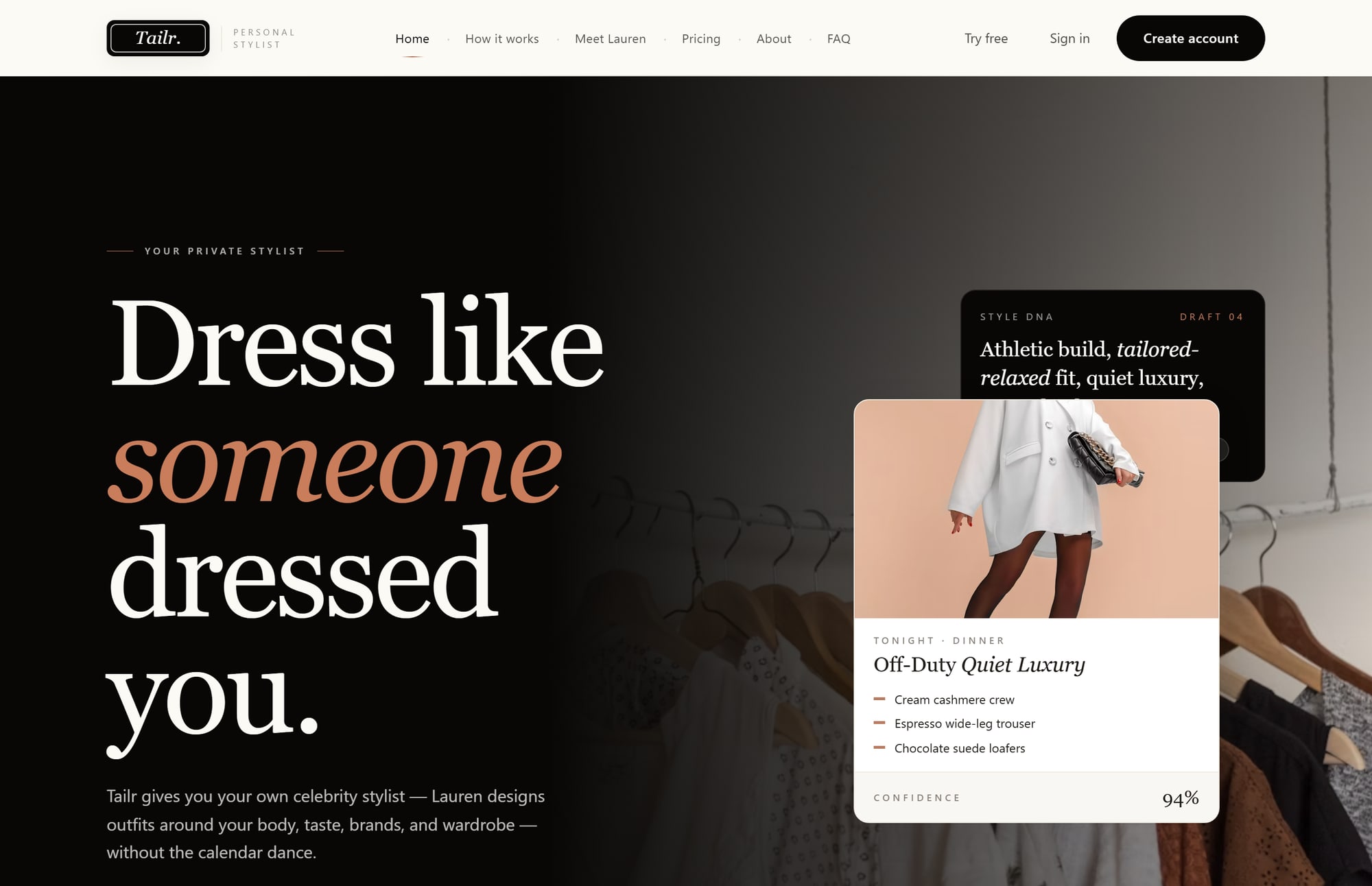
Exhibit 01
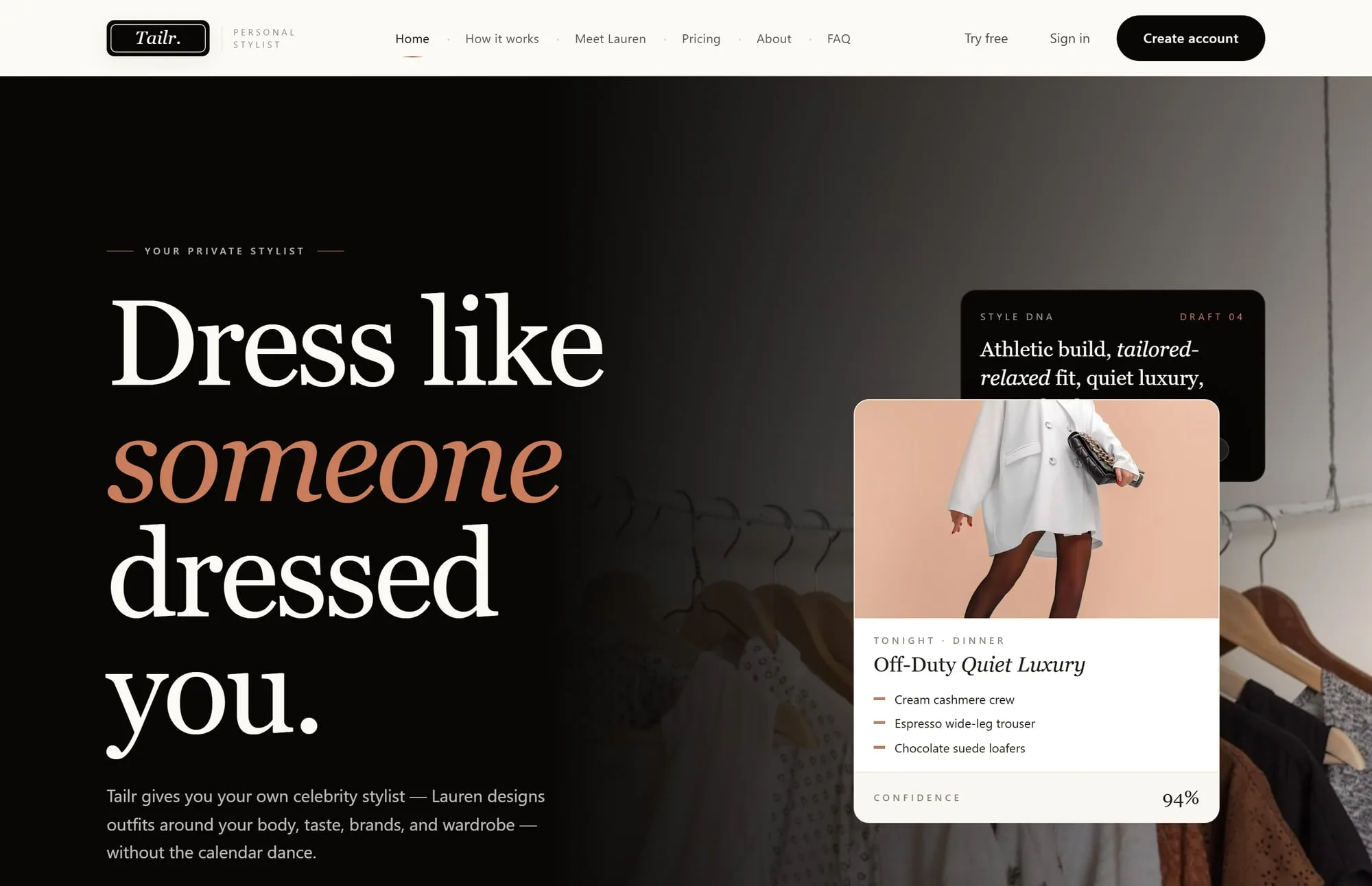
The brand and the product promise in one screen — CMA wrote, designed and shipped both.
Select the image to inspect the full screenshot.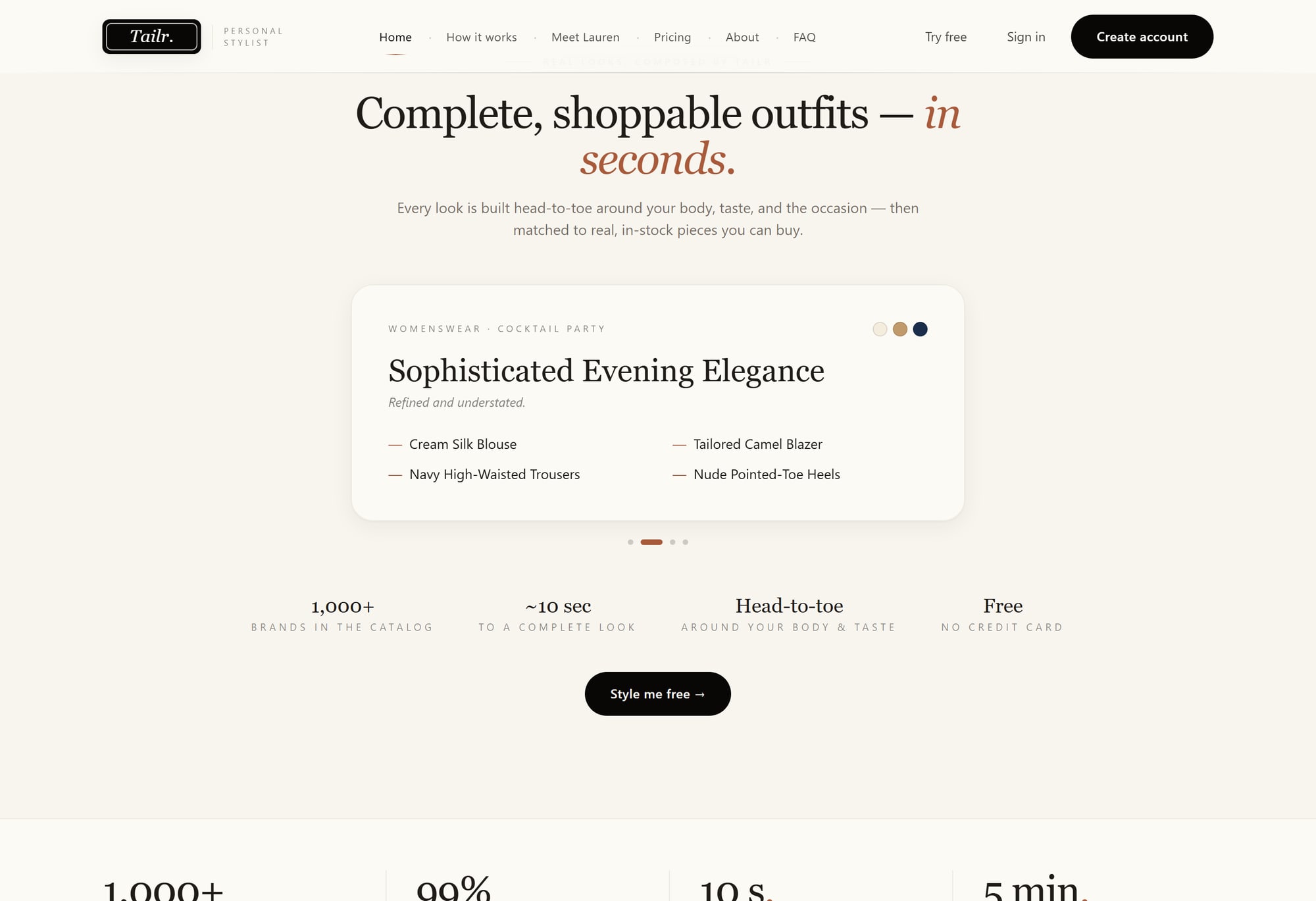
Exhibit 02
Every look is head-to-toe and shoppable, matched to real in-stock pieces.
Select the image to inspect the full screenshot.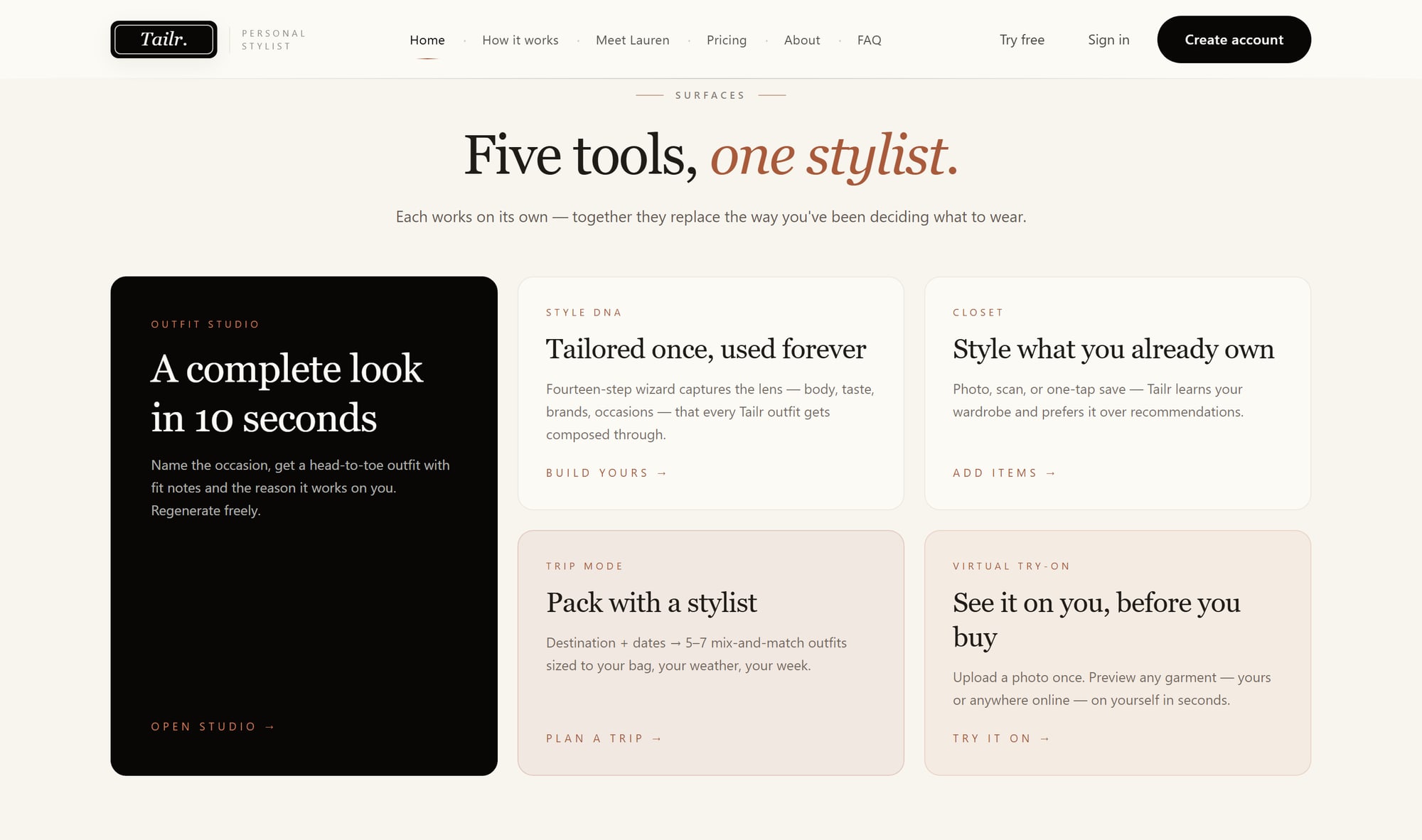
Exhibit 03
Five surfaces, one stylist — each usable on its own.
Select the image to inspect the full screenshot.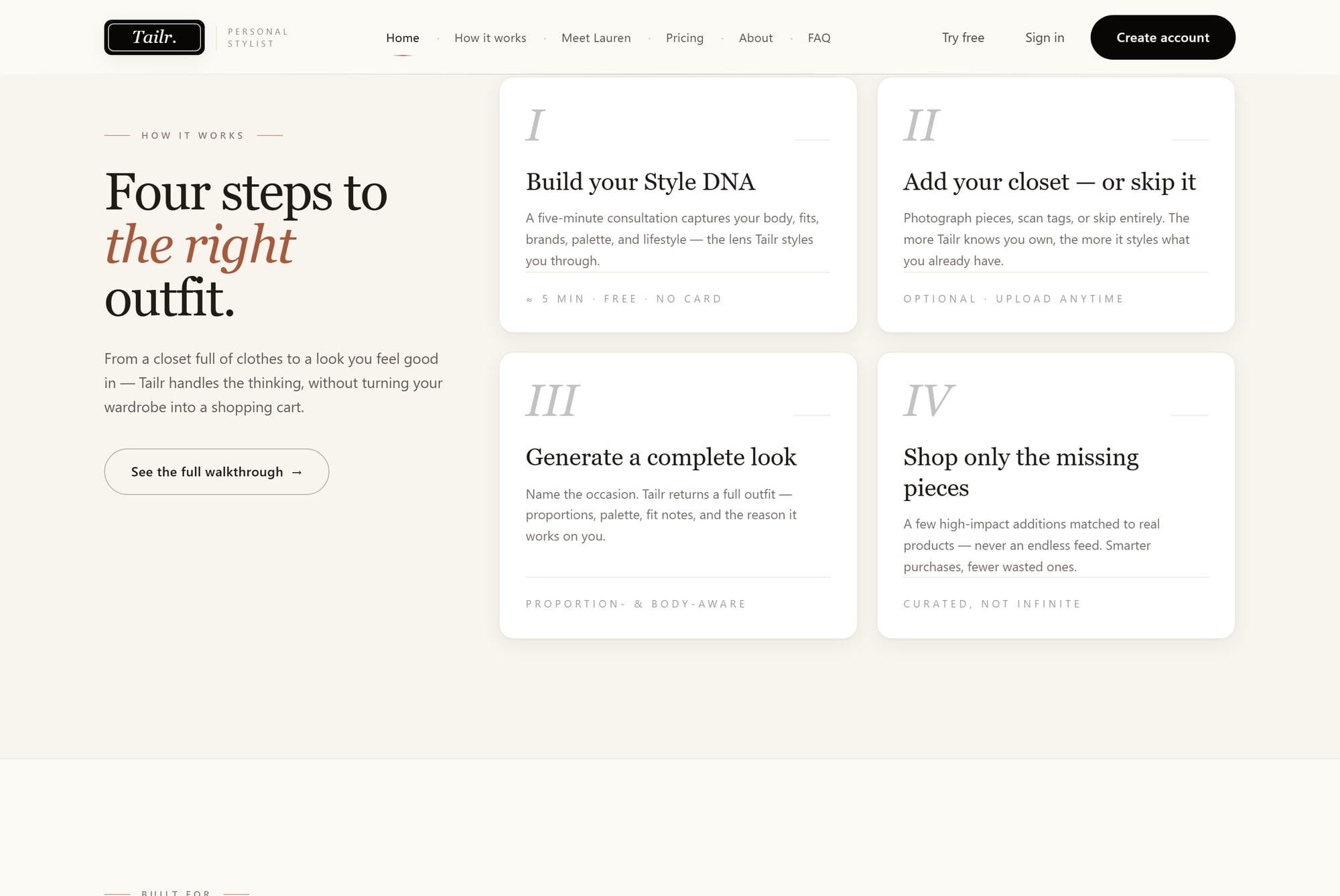
Exhibit 04
Four steps from a cold start to a complete outfit.
Select the image to inspect the full screenshot.The problem: styling advice with no memory of the wardrobe
A product feed can show attractive clothes. It cannot, by itself, answer the harder question: what should this person wear, given their preferences, the occasion and what they already own? A generic AI answer has the same weakness if every interaction starts without context.
Tailr needed a coherent consumer product. The promise on the marketing page, the questions in onboarding and the resulting outfit had to describe the same experience. If the website promised a personal stylist but the product returned a loose list of garments, the handoff would fail.
CMA’s scope joined the work that often gets split between a brand agency, a website provider and an application team: identity, marketing site and the product experience itself. The gallery above shows those parts together, rather than asking the reader to take the delivery claim on trust.
The build decision: one profile, several useful surfaces
The product architecture centers on Style DNA, a shared profile of body, aesthetic, brands and lifestyle. Outfit Studio, Trip Mode and Ask Tailr can read that profile instead of asking the user to repeat the same information each time.
The design consequence is practical. Onboarding is not a questionnaire detached from the product. Its answers have a job: make later recommendations more specific. The profile screen in the walkthrough establishes the inputs; the outfit screen shows the output those inputs are intended to shape.
| Product decision | What the user does | What the experience needs to preserve |
|---|---|---|
| Shared profile | Describes their style and preferences | Context across product surfaces |
| Closet-aware styling | Adds photographs of clothes they own | Existing garments as usable inputs |
| Complete looks | Names an occasion | A coordinated outfit rather than unrelated products |
| Shoppable results | Reviews the pieces in a look | A path from recommendation to the relevant garments |
| Trip planning | Plans for a destination | A coherent set of outfits rather than independent picks |
A concrete user journey: from a wedding invitation to a complete look
The local product recording includes an occasion-based example. A visitor chooses a wedding-guest scenario. The next screen presents a coordinated ensemble, individual pieces and a written explanation of the styling.
That example matters because it makes the product’s unit of value visible. The output is not “we added AI.” It is a decision the user can act on: these pieces, together, for this occasion, with an explanation. The interface also demonstrates a color-analysis flow, taking appearance inputs through to a seasonal palette.
The screenshots show other parts of the same system: the product promise, outfit cards and the relationship between the five surfaces. They are examples of the delivered interface, not testimonials or measured shopping outcomes.
What CMA delivered across brand, website and product
Brand and positioning. A consumer-facing identity and a specific promise: styling built around the person and their wardrobe. The visual system carries from the landing page into the product.
Marketing website. A route from understanding the offer to trying it. The public pages explain the experience through real product views rather than abstract AI imagery.
Product onboarding. A structured profile that gives later screens context. This connects the information a user supplies to a reason for supplying it.
AI experience. Outfit generation, closet-aware styling, trip planning and virtual try-on are distinct surfaces in the product. They serve related tasks while retaining a common profile.
Commercial handoff. The portfolio documents a free starting experience and a purchase-based Pro entitlement. That is an implementation decision, not a claim about current conversion, revenue or customer lifetime value.
Why the implementation choices matter to another business
An AI feature becomes a product when the surrounding workflow works. For a different business, the equivalent of the wardrobe might be an existing account, a set of approved documents or a customer’s prior choices. The question is what context must survive between the first input, the generated answer and the next action.
Before commissioning a similar build, write down the decision the user needs to make, the inputs the system can legitimately use, the output they can inspect and what happens when they accept it. Those four items give a much stronger scope than “an AI app.”
CMA’s process automation practice covers the workflow and system side; website services cover the public experience. The Tailr portfolio provides the companion product walkthrough. For market positioning before a launch, see go-to-market strategy.
What this case proves
The evidence is a shipped product experience spanning brand, website and application, illustrated with the real interface and a product recording. It demonstrates the connected workflow. Adoption, retention and financial return require their own operating data; none is implied by the screenshots.
Engagement details are shared with client permission or presented in anonymized form. Results described are specific to the engagement and client circumstances shown and are not a guarantee of future outcomes. See our full disclaimer.
FAQ
Questions about this build
What did CMA build for Tailr?
CMA built Tailr’s brand and identity, marketing website and AI product experience. The documented surfaces include Style DNA, Outfit Studio, the closet, Trip Mode and virtual try-on.
How is this different from an AI chatbot added to a website?
The product uses a shared profile across styling surfaces and accounts for clothes the user already owns. Recommendations are presented as complete outfits with pieces and styling explanations, rather than a standalone chat response.
What can an owner learn from this AI product case study?
Start with the customer decision, define the information needed to make it, then connect onboarding, generation and the next action. The screenshots and walkthrough demonstrate that sequence; they do not establish a revenue or adoption result.
Related engagements
Free Roadmap
The 90-day launch roadmap.
Three phases, ninety days, in the order that keeps launches from stalling: legal and financial foundations first, brand and systems second, customers third.
- Days 1-30: structure, EIN, bank account, bookkeeping
- Days 31-60: positioning, website, pricing, first SOPs
- Days 61-90: soft launch, first channel, reviews
- Three north-star numbers to hit by day 90