
Real Estate
DW Capital: Connecting Leases, Short-Term Stays and Owner Reporting
DW Capital Holdings
By Dallas Coleman · Updated
Inside the build
The product. The workflow. The work you can see.
The DW Capital platform connects properties, units, leases, charges, payments and maintenance while supporting short-term channel calendars, turnovers and owner statements. Separate staff, owner, resident and contractor views expose the part of the workflow each person needs, over the same underlying records.
- Built for
- DW Capital Holdings
- Work delivered
- Web Apps · Dashboards · Process Automation
DW Capital property platform: calendars, turnovers and owner statements
A screenshot walkthrough of channel calendars, turnovers and owner statements: three connected views of the property operation.
Read the video description
- 00:00 — The listings view brings short-term channel calendars and upcoming stays into one property workspace.
- 00:06 — The turnovers board organizes cleaning between stays, connecting the calendar to the operating task.
- 00:12 — The owner-statement screen prepares reporting for one owner and month. Sent statements are retained as snapshots.
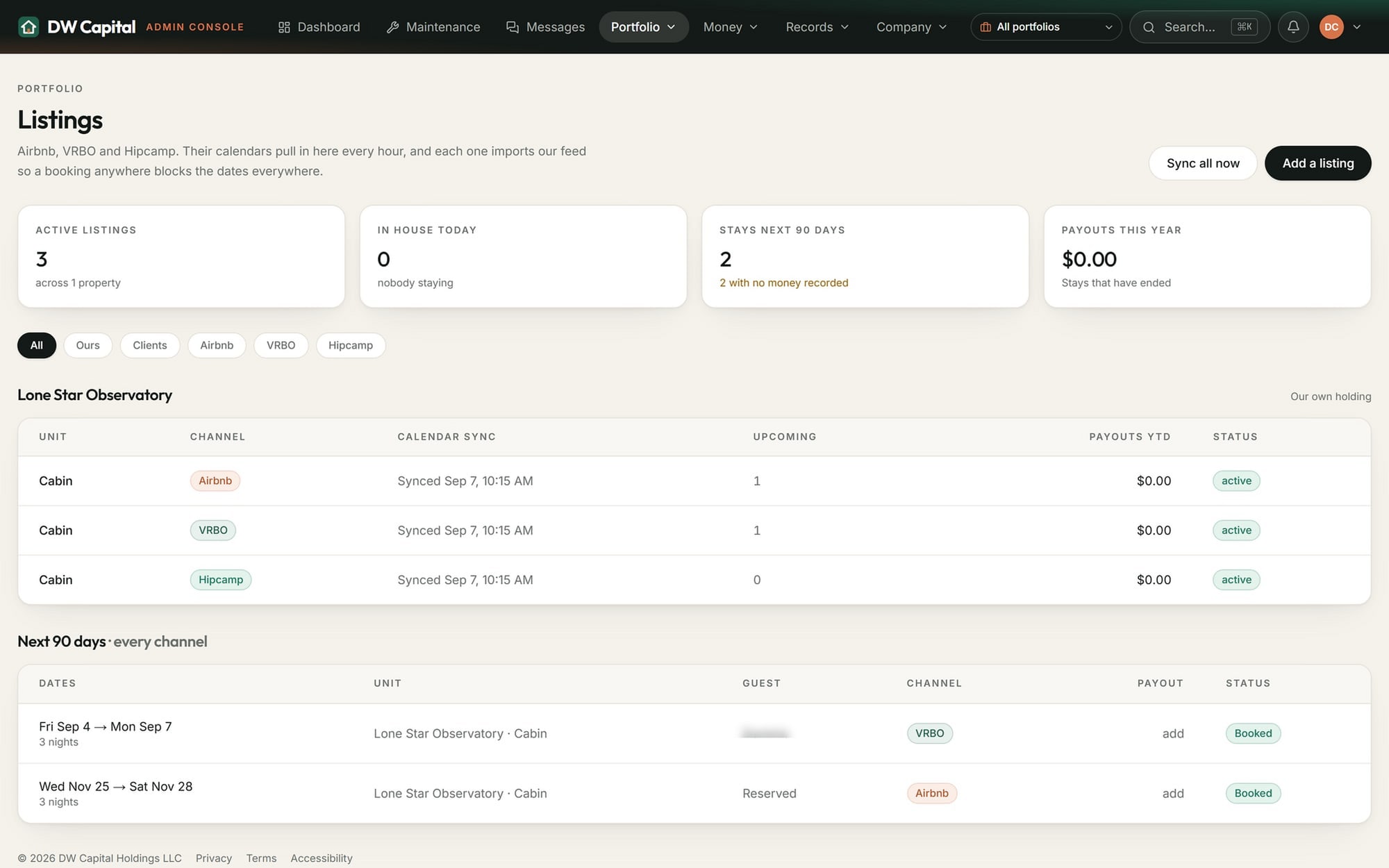
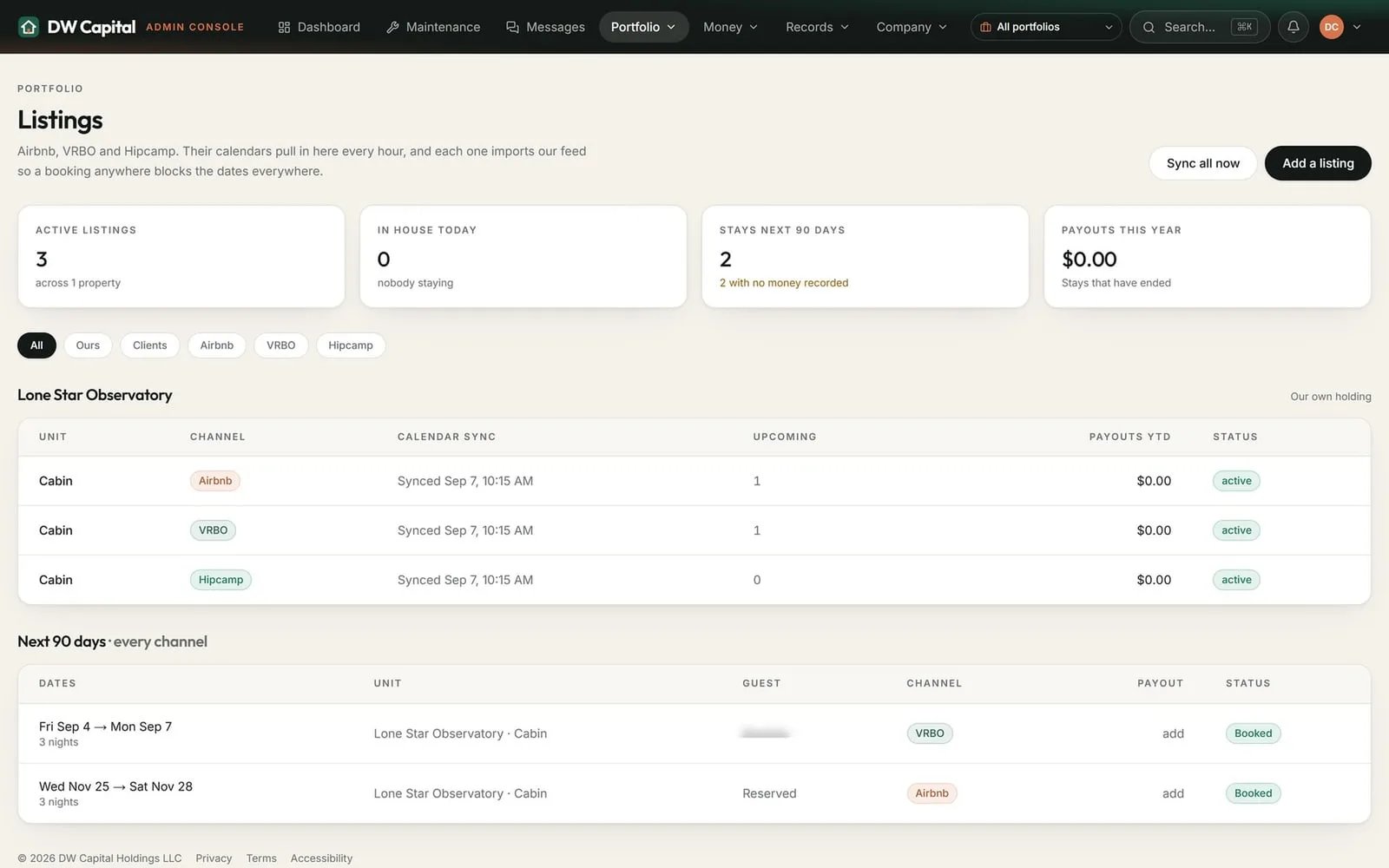
Exhibit 01
Three channels on one unit, each calendar synced hourly, with upcoming stays from every source in one list.
Select the image to inspect the full screenshot.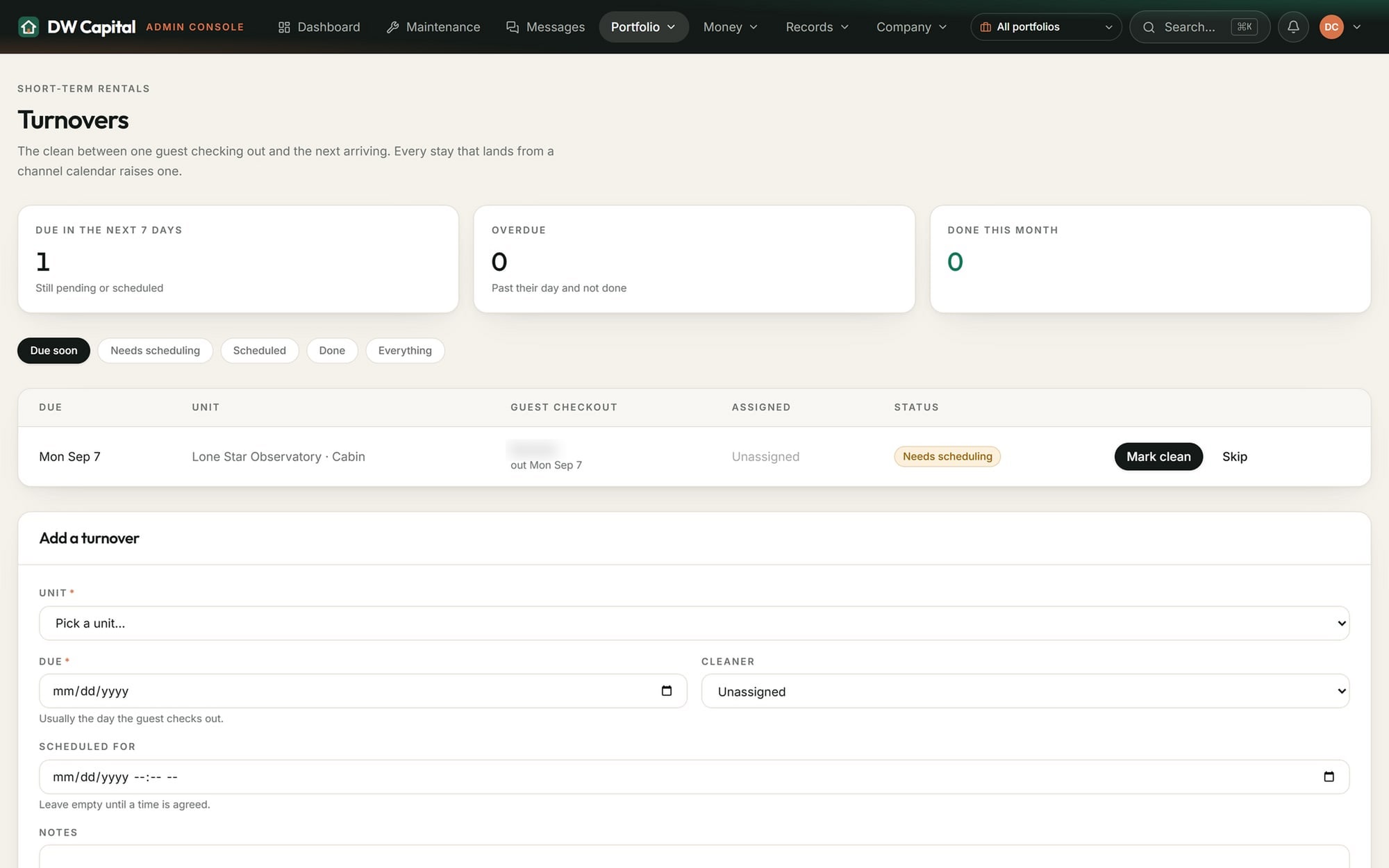
Exhibit 02
Turnovers scheduled off the booking calendar, so a clean is never the thing that was forgotten.
Select the image to inspect the full screenshot.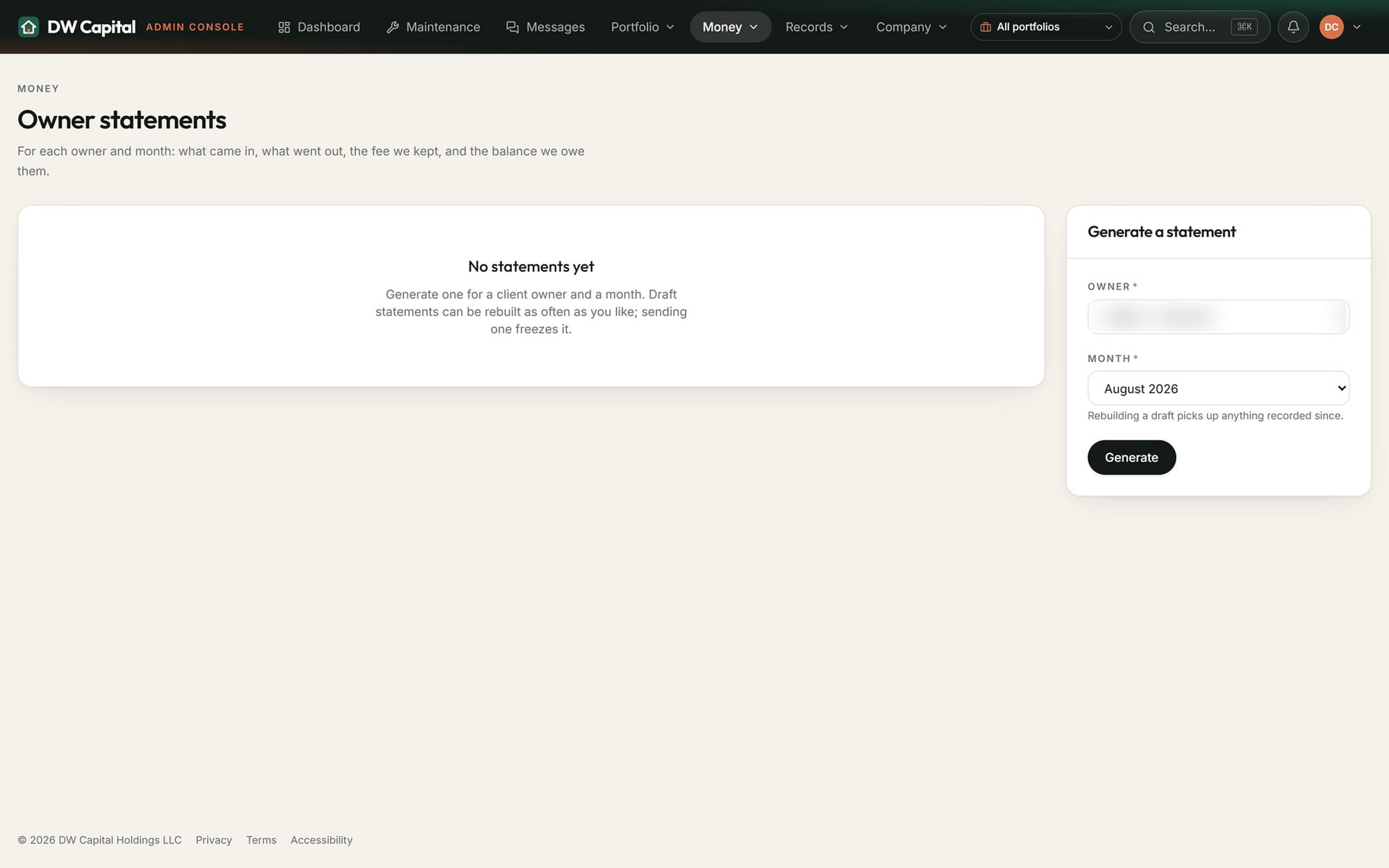
Exhibit 03
A statement is generated per owner and month. A draft can be rebuilt as often as you like; sending one freezes it.
Select the image to inspect the full screenshot.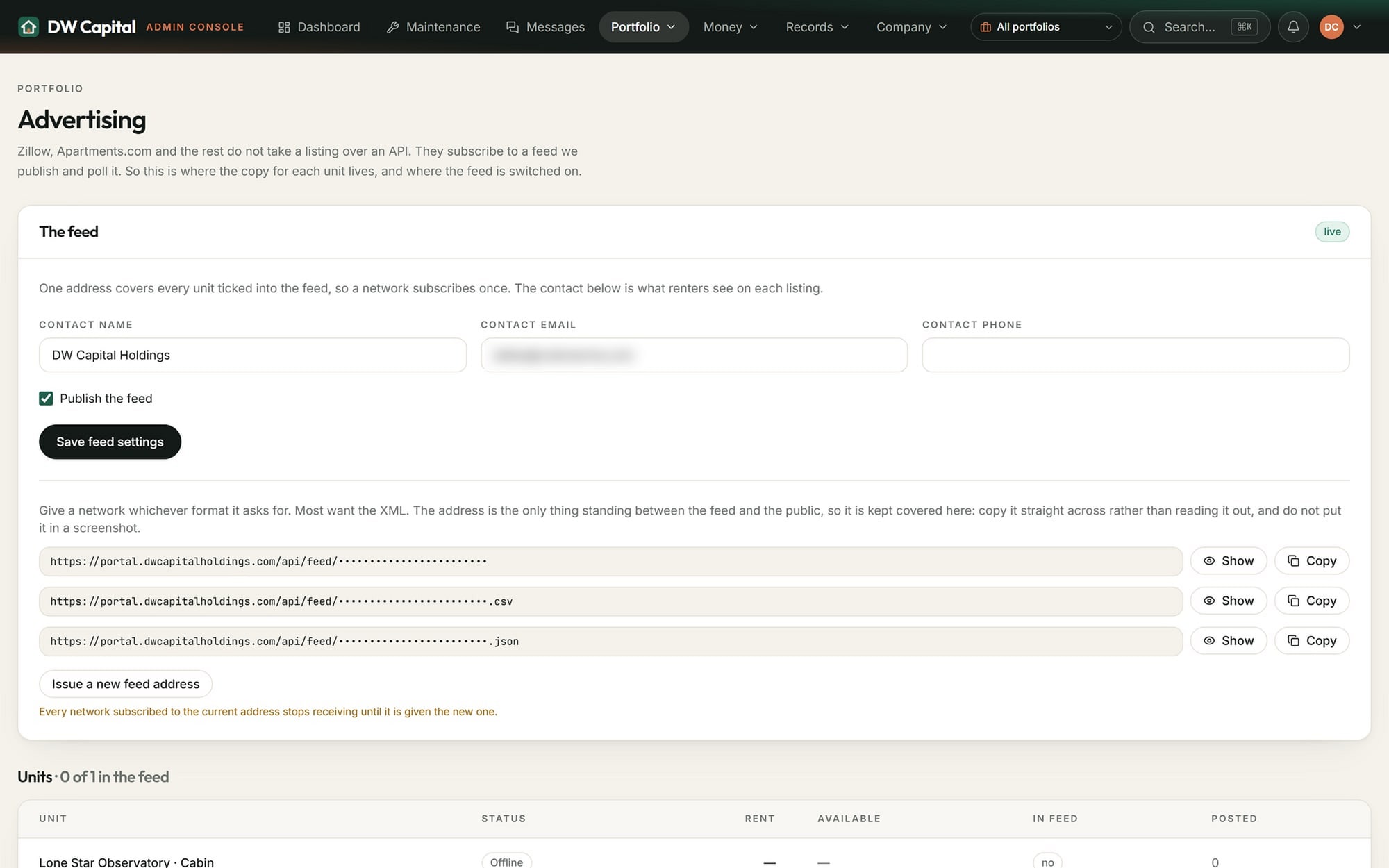
Exhibit 04
Listing-feed addresses are bearer credentials, so the page keeps them covered — copy still works, the value is never left on screen.
Select the image to inspect the full screenshot.The problem: one portfolio, two operating models
A long-term rental revolves around the lease: the resident, rent due, charges, payments and maintenance. A short-term stay revolves around availability, a channel booking, the turnover between guests and the earnings that arrive through a separate record.
DW Capital Holdings operates a Texas portfolio with both types of work and manages property for other owners as well as its own. A useful system had to support those differences without turning each into a disconnected product. An owner asking about a statement, a resident reporting a repair and a contractor receiving a work order should ultimately refer to the right property and records.
The case is about that operating design. The screens above show the product surfaces. The workflow below explains why they are connected the way they are.
The lease is the spine of the long-term workflow
The core relationship is property → unit → lease → charges and payments. Maintenance requests and work orders attach to the same operating context rather than living only in email.
That relationship determines the handoffs. A public application leads toward a tenancy. A resident request can become a staff-triaged work order. A contractor receives their own view of the assigned work. The record stays associated with the unit as responsibility changes.
The platform also uses a portfolio switcher so the operator can work within DW’s own holdings or the managed owner’s properties. This is an operating boundary, not just a different color on a dashboard.
Four front doors over shared records
| Person | Work they need to do | Why a separate view matters |
|---|---|---|
| Staff | Coordinate property operations | They need the cross-property working view |
| Owner | Review their properties and statements | They should see their own holdings and reports |
| Resident | Participate in the tenancy and raise requests | The unit and lease provide the context |
| Contractor | Receive and work an assigned order | The task should arrive without the entire management workspace |
The published architecture uses database row-level rules behind these surfaces. The important buyer question is what a role may see and do; the interface alone is not the full access boundary.
Short-term operations: a calendar is not a financial ledger
The listings exhibit shows channel-calendar coordination. The documented build supports Airbnb, VRBO and Hipcamp calendars, synchronizing availability through iCal. This case describes the connection used in this implementation; it is not a claim that a channel offers no other integration to any business.
An availability record does not establish cash received. Earnings therefore come from transaction exports, matched on confirmation code and then dates, with review before writing. Calendar coordination and financial reconciliation are treated as separate jobs.
That distinction prevents a misleading shortcut: showing a booked night as if it were collected revenue. It also makes the review point explicit. Imported records should not become financial truth simply because a file arrived.
From a stay to a turnover
A calendar is operationally useful only if the next task happens. The turnover board connects the space between stays to cleaning work. It gives the operator a way to manage the handoff rather than relying on somebody to remember the gap in the calendar.
The same principle applies to maintenance. A resident raises the issue, staff triage it and a contractor receives the work order. Different people participate, but the unit remains the organizing record. These are two examples of the same design choice: attach the handoff to the work, not to an inbox.
Owner statements: preserve the report somebody actually read
The statement exhibit shows a report prepared for one owner and month. The documented operating rule bases statement income on money received and calculates the management fee from it. Draft statements can be rebuilt while the period is being prepared.
Sending changes the rule. The statement becomes a snapshot. Later changes do not silently rewrite the report already delivered to the owner.
For a manager, that means a question can refer to a specific sent statement rather than an ever-changing total. It is a recordkeeping decision that belongs in the workflow from the beginning, not an explanatory footnote after a disagreement.
What another property operator should specify before a build
Start with the records that must agree: property, unit, tenancy, stay, payment and work order. Then list who needs each record and which transitions require a review. A useful first scope can name the handoffs that currently fail rather than trying to copy every feature of a national property-management suite.
The delivered scope here also includes rent and payment workflows, owner reporting and the interfaces shown in the DW Capital portfolio. The relevant CMA offer is an owned operations platform, supported by process optimization when the underlying handoff needs redesign before software.
What changed
The result is a connected operating platform for a mixed portfolio, with distinct role surfaces and explicit review points between calendars, transaction records and owner reports. The exhibits demonstrate the delivered functionality. They do not claim an occupancy increase, investment return or audited reduction in staff hours.
Engagement details are shared with client permission or presented in anonymized form. Results described are specific to the engagement and client circumstances shown and are not a guarantee of future outcomes. See our full disclaimer.
FAQ
Questions about this build
What does this property management platform connect?
It connects the property, unit and lease records to billing and maintenance, with short-term calendar coordination, turnovers and owner reporting on top. Staff, owners, residents and contractors have separate views.
Why are calendar data and earnings handled separately?
A channel calendar indicates availability and stays, not money received. This build uses channel transaction exports for earnings, reviewed before writing, instead of treating a calendar entry as proof of revenue.
What happens when an owner statement is sent?
The sent statement is retained as a frozen snapshot. It is not silently recalculated when later records change, so the owner and manager can refer to the same report.
Related engagements
Free Starter Kit
Write the first SOP this week.
The SOP starter kit: the five things every procedure needs, a worked example you can copy, and a blank template, so what lives in your head becomes something the business can run on.
- The five parts every SOP needs
- A worked example: new client onboarding
- A blank template to copy per task
- Where to start: the 3-5 tasks that break when you are away